How much sand and cement for a patio, and how many slabs?
To lay a patio of paving slabs on a full mortar bed you need the slabs, sharp sand and cement for the bed, a sub-base under it, a slurry primer for the backs of the slabs and a jointing compound, each counted from the patio’s area. A 4 m × 3 m patio of 600 × 600 mm slabs with a 10 mm joint takes 36 slabs with 10% for cuts, 1 bulk bag of sharp sand and 6 bags of 25 kg cement for a 30 mm bed at 1 : 4, 3 bulk bags of Type 1 for 100 mm of sub-base, 1 tub of primer and 2 pails of jointing. The slab and the 10% are generic examples; the bed, the mix and the sub-base are the figures of two makers’ laying guides; what each bag, tub and pail holds is a typical figure, named below.
Work out the slabs, sand and cement for a patio
The five figures
- The area. Length times width for a rectangle, in metres. A patio that is not a rectangle can be drawn in the calculator, or split into rectangles.
- The slab and its joint. One slab covers its own size plus one joint each way, because each joint is shared. Marshalls’ guide gives a joint of at least 10 mm and does not recommend butting slabs together.
- The allowance for cuts. BuildBatch starts at a labelled 10%, as for tiles and flooring; neither guide gives a figure.
- The bed’s depth and mix. Both guides lay slabs on a full bed of mortar, never on dabs: Marshalls 30 to 40 mm at 1 part cement to 3 or 4 parts sharp sand, Bradstone 30 mm at 4 parts sharp sand to 1 of ordinary Portland cement.
- The sub-base’s depth. Both guides give 100 mm of compacted Type 1 (MOT) as the usual minimum, laid in layers with a plate compactor. The ground and what the patio is for decide the depth: enter yours and the count follows it.
The sum
- Slabs: the area ÷ (the slab’s width + the joint) × (its length + the joint), with both in metres; add the allowance once and round up to whole slabs.
- The bed: the area × the bed’s depth ÷ 1,000 is the bed in cubic metres. The dry sand and cement that make it take about a third more room than the finished mortar, so the bed × 1.3 is the dry materials. Split that by the mix: at 1 : 4, four fifths is sand and one fifth is cement. Then divide each by what one bag holds and round up.
- Sub-base: the area × the depth ÷ 1,000 is the compacted volume; divide by what a bag holds at a compacted depth and round up.
- Primer and jointing: the area ÷ what one tub or pail covers, rounded up.
No allowance for waste is added to the bed or the sub-base: the 1.3 is the room the dry materials take, not spare.
Worked example
| Working | Figure | Result |
|---|---|---|
| Patio area | 4 m × 3 m | 12 m² |
| One 600 × 600 mm slab with a 10 mm joint | 0.61 m × 0.61 m | 0.3721 m² |
| Slabs | 12 ÷ 0.3721 = 32.25, plus 10% = 35.47 | 36 slabs |
| The bed at 30 mm | 12 × 30 ÷ 1,000 | 0.36 m³ |
| Dry sand and cement | 0.36 × 1.3 | 0.468 m³ |
| Sharp sand, 4 of 5 parts | 0.374 m³ ÷ about 0.5 m³ a bulk bag | 1 bulk bag (or 25 bags of 25 kg) |
| Cement, 1 of 5 parts | 0.094 m³ = 93.6 L ÷ about 17 L a 25 kg bag | 6 bags |
| Sub-base at 100 mm | 1.2 m³ ÷ about 0.45 m³ a bulk bag | 3 bulk bags (or 86 bags of 25 kg) |
| Primer | 12 m² ÷ about 12 m² a tub | 1 tub |
| Jointing | 12 m² ÷ about 7 m² a pail | 2 pails |
With 450 × 450 mm slabs and the same joint, each covers 0.2116 m², so the same patio takes 63 slabs; with 900 × 600 mm slabs, 0.5551 m² each, it takes 24. The bed, the sub-base, the primer and the jointing do not change with the slab.
Slabs per square metre
Each slab covers its own size plus half the joint on every side, so with a 10 mm joint a 600 × 600 mm slab covers 0.61 × 0.61 = 0.3721 m², and a square metre takes 1 ÷ 0.3721 = 2.69 of them before any allowance for cuts. For the six sizes the patio calculator offers, with the 4 m × 3 m patio’s count at 10% for cuts:
| Slab | Covers with a 10 mm joint | Slabs a square metre | The 4 × 3 m patio, with 10% |
|---|---|---|---|
| 600 × 600 mm | 0.3721 m² | 2.69 | 36 |
| 450 × 450 mm | 0.2116 m² | 4.73 | 63 |
| 900 × 600 mm | 0.5551 m² | 1.80 | 24 |
| 600 × 300 mm | 0.1891 m² | 5.29 | 70 |
| 400 × 400 mm | 0.1681 m² | 5.95 | 79 |
| 300 × 300 mm | 0.0961 m² | 10.41 | 138 |
A wider joint or a laying pattern that mixes sizes changes the count: enter the slab and the joint from the pack.
Where the typical figures come from
What a bag, tub or pail holds is not a maker’s figure for your product, so each one is a typical figure, labelled as such on the list and named here. Replace it with the figure on what you buy and the count follows it.
- A bulk bag of sharp sand, about 0.5 m³: a merchant’s own pages for its bulk bags of sharp sand, ballast and shingle, “approximately 0.5 cubic metre, 800-850 kg” (M&P Moran, read on 10 October 2026). A 25 kg bag at the same weight for its volume is about 0.015 m³.
- A 25 kg bag of cement, about 17 litres: the density figure trade calculators use for cement, 1,440 kg/m³. No maker’s data sheet read publishes a bag’s volume.
- The dry materials, 1.3 times the bed: two UK mortar calculators give the factor as 1.27 (materialcalculator.co.uk) and 1.33 (mixdesigncalc.co.uk), read on 11 October 2026. No maker’s figure was found.
- A bulk bag of Type 1, about 0.45 m³: Materials Market’s own words for its 800 kg bag, “typically covers approximately 4-5m2 when installed at a compacted depth of 100mm”, in its product feed of 9 October 2026. A 25 kg bag at the same weight for its volume is about 0.014 m³.
- Primer, about 12 m² a tub, and jointing, about 7 m² a pail: the stated coverages of Pavetuf Grey Priming Slurry (a 17 kg tub) and Marshalls Weatherpoint 365 (a 15 kg tub), as Travis Perkins’ product feed of 9 October 2026 describes them.
The typical figures and where they were read are listed with links on the methods page.
What else the job needs
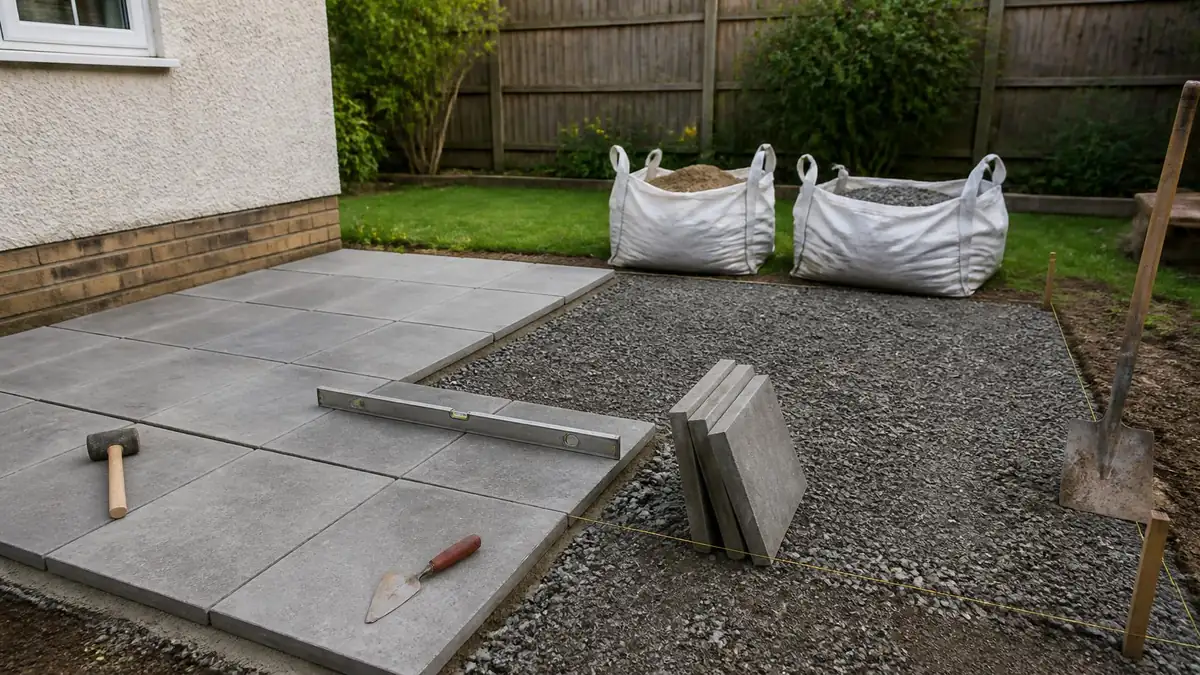
The list starts these as Need: string line and pegs, a spirit level, a straight edge, a rubber mallet, a trowel and a shovel, and gloves, long sleeves, safety boots, eye protection and a dust mask. It starts these as Check first, because the ground and the design decide them: a geotextile membrane under the sub-base, an edge restraint or haunching on the edges not against a wall, sheeting to cover the work, and a mixer, a plate compactor and a diamond-blade saw, usually hired.
The sum decides no fall, no level against the damp-proof course, no drainage and no sub-base for the ground you have. Both guides lay a patio with a fall away from the house, Bradstone around 1 in 60 and Marshalls 1 in 80 along and 1 in 40 across, and its surface at least 150 mm below the damp-proof course. Both cut slabs with a water-fed diamond blade and the protective equipment for it: the dust from cutting is a hazard. Wet mortar burns skin. Block paving on a sand bed is a different job, and this guide does not cover it.
What it costs to have it laid
The published labour rates BuildBatch has collected for laying a patio are on the labour costs page, each with its publisher, what it includes and its date. The patio calculator shows the same rates under its list, worked on your patio’s area. They are published figures, not quotes, and not BuildBatch’s own.
Do it with BuildBatch
Open the patio calculator, enter the patio’s length and width or draw its shape, tap your slab’s size and choose bulk bags or 25 kg bags. The list counts every line above, says on each one which figure is typical and where it was read, and takes the figures from your own bags, tubs and pails when you enter them. For other sizes, a table by patio size gives the slabs, the sand, the cement and the Type 1 for ten patios from 2 × 3 m to 6 × 6 m.
Sources
- Marshalls: Natural Stone Paving Installation Guide, Issue 5, January 2020, read in full on 10 October 2026: the sub-base, the bed’s depth and mix, the primer, the joint, the fall, the depth below the damp-proof course, the cutting and the weather.
- Bradstone: How to lay Concrete Paving, 10 June 2024, read in full on 10 October 2026: the excavation, the sub-base, the bed and its mix, the primer, the fall and the depth below the damp-proof course.
- Sika: Sika FastFix All Weather, product data sheet, February 2025, read in full on 10 October 2026: what a pail of jointing covers at its own joint.
Questions
How many paving slabs per square metre?
With a 10 mm joint, 2.69 slabs of 600 × 600 mm, 4.73 of 450 × 450 mm and 1.80 of 900 × 600 mm, before the allowance for cuts: each slab covers its size plus the joint. A 4 m × 3 m patio of 600 × 600 mm slabs takes 36 with 10% for cuts.
How many paving slabs for a 4 m by 3 m patio?
The patio is 12 m². A 600 × 600 mm slab with a 10 mm joint covers 0.3721 m², so 12 ÷ 0.3721 = 32.25 slabs; with 10% for cuts that is 35.47, so 36 slabs. The slab size and the 10% are generic examples; the 10 mm joint is the minimum one maker's laying guide gives. Use your own slab's size.
How much sand and cement do I need for a patio?
For the mortar bed, the area times the bed's depth: 12 m² at 30 mm is 0.36 m³. The dry sand and cement take about a third more room than the bed they make, so 0.468 m³ of dry materials, which at 1 part cement to 4 parts sharp sand is 0.374 m³ of sand and 0.094 m³ of cement: 1 bulk bag of sand (or 25 bags of 25 kg) and 6 bags of 25 kg cement. The bed, the mix and what each bag holds are typical figures named in this guide.
What mix do I lay patio slabs on?
The two makers' laying guides read give a full bed of 1 part cement to 3 or 4 parts sharp sand (Marshalls) and 4 parts sharp sand to 1 of ordinary Portland cement (Bradstone), 30 mm or more deep before the slab is tapped down. Sharp sand, not building sand; ordinary Portland cement, not white.
How much sub-base for a patio?
Both guides give 100 mm of compacted Type 1 as the usual minimum; the ground and the use decide it. 12 m² at 100 mm is 1.2 m³ compacted: 3 bulk bags at about 0.45 m³ a bag, or 86 bags of 25 kg. The bag's figure is given for the material compacted in place, so nothing is added for settlement.
How much jointing compound for a patio?
It is on the pail, and it depends on the joint's width and depth and the slab's size. One compound is described as covering 7 m² a 15 kg tub, so 2 pails for 12 m²; another gives 17 to 21 m² a pail for 450 mm slabs with 5 × 20 mm joints. Read the pail for your joint.