What you need to fit skirting board: the full list
To fit new skirting board you need the skirting in whole lengths, counted from a cutting plan, grab adhesive or nails or screws, primer, undercoat and a top coat for the new boards, decorator’s caulk and wood filler, a mitre saw or a mitre box and a fine saw, a tape measure, a pencil, a hammer, a nail punch and a caulking gun, and a dust mask, eye protection and gloves. Taking off the old skirting is on the list too. The lengths, the saw, the other tools and the safety kit start as Need; the rest are lines to Check first. A 4 m × 3 m room takes 6 lengths at the example length of 2.4 m.
Work out the skirting for a room
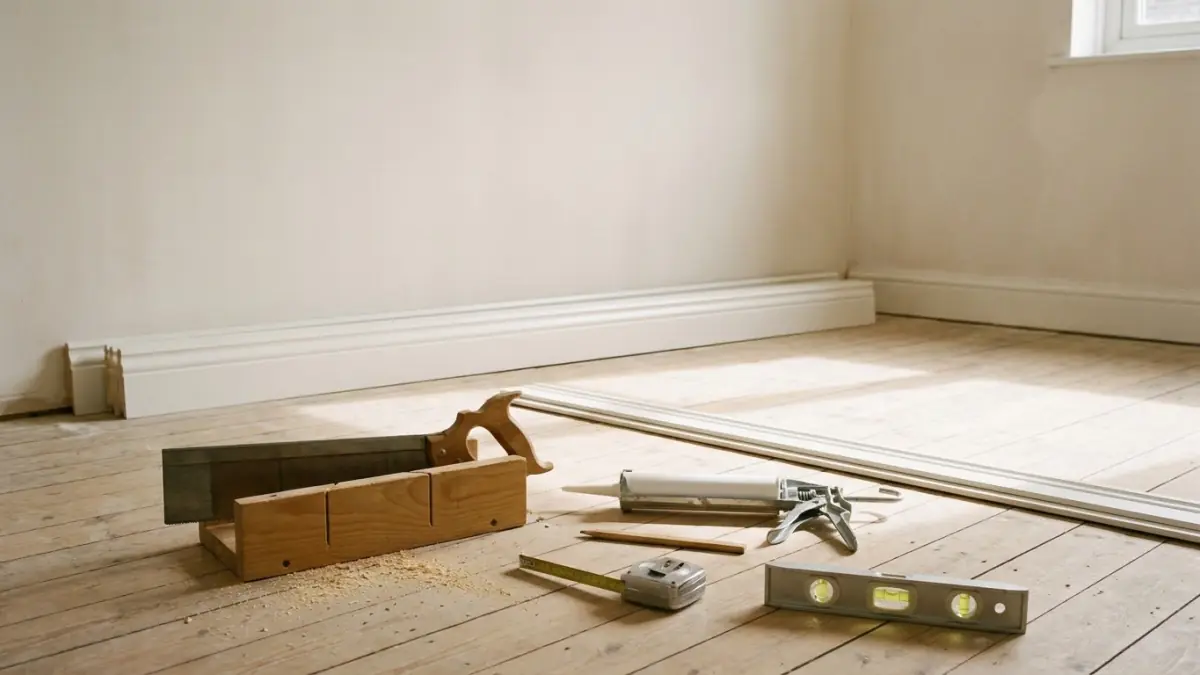
The checklist
These are the lines BuildBatch lists for new skirting boards, in its order, with the mark each one starts with. “Check first” means it may need buying, and something the list cannot know decides it.
| Item | Starts as | Why it is on the list |
|---|---|---|
| Skirting board, in whole lengths | Need | The wall round the room, one piece a wall, cut from whole lengths in a cutting plan |
| Taking off the old skirting | Check first | The old boards come off first, prised away from the wall |
| Grab adhesive, or nails or screws | Check first | To fix the new board to the wall, counted by the length of board |
| Primer, undercoat and a top coat for the new boards | Check first | New skirting and architrave are sold bare, primed or finished; the label says which |
| Decorator’s caulk and wood filler | Check first | Caulk fills the gap along the top edge; filler covers the nail holes and the joins |
| Mitre saw, or a mitre box and a fine saw | Need | To cut to length and mitre the external corners; internal corners are mitred or scribed with a coping saw |
| Tape measure, pencil, hammer, nail punch and a caulking gun | Need | To mark, fix and finish the boards |
| Dust mask, eye protection and gloves | Need | Cutting boards makes dust, and the old boards come off with splinters and nails |
Any line can be marked Already have or Not needed in the planner.
What decides how much
- Skirting. One piece for each wall, 5 cm longer for the corner cuts; a wall longer than the length sold is joined, with 5 cm more for the join. Doorways are not taken off: the short runs beside a door usually come out of the same lengths. The number of lengths comes from cutting those pieces out of whole lengths, and it is often one more than the perimeter suggests. The sum is in how much skirting and architrave do I need?
- The length sold. BuildBatch starts with 2.4 m as a labelled example. Another length can change the count, so the length on your shelf’s label replaces it.
- Architrave, if you add it. On this side of each door only, two legs (the door’s height plus 5 cm) and a head (its width plus 25 cm), never joined. The other side belongs to the next room.
- Fixing and finish. BuildBatch gives the length of board to fix and to finish, and no count of cartridges or tins: the cartridge and the tin say how far they go.
- Caulk. One tube of caulk usually runs a room’s skirting; the tube says how far it goes.
- Tools and safety kit. BuildBatch gives no count for these.
What to check first
These are the planner’s own checks, line by line.
- The old skirting. A pry bar and a wide bolster. Look out for pipes and cables behind the skirting, and for old paint that may contain lead: do not sand it.
- The lengths. Buy the lengths together, from one batch: the profile and the finish can differ between batches and makers.
- The fixing. Adhesive on a sound, flat wall; nails or screws into timber or plugs on an uneven one. The cartridge says how far it goes.
- The finish. Primed boards still need a top coat; bare timber needs knotting and primer first. The tin says how far it goes.
With a new floor, fit the new skirting after the floor: it sits on the floor and covers the expansion gap, so beading may not be needed. See how to measure for skirting board, beading and scotia.
Worked example
A room 4 m × 3 m with one internal door 762 mm wide, and skirting sold in 2.4 m lengths. That length is the planner’s generic example, not any product’s.
- Skirting board: 14 m of wall round the room, four walls, each cut 5 cm long for the corners. Every wall is longer than one length, so each takes a whole length and an end joined on: four whole lengths, and ends of 1.7 m, 0.7 m, 1.7 m and 0.7 m, with the join allowance in them. A 1.7 m end and a 0.7 m end share a length, so the ends come from 2 more. That is 6 lengths of 2.4 m, 14.4 m, with none left over. Need.
- Taking off the old skirting: Check first.
- Grab adhesive, or nails or screws: about 14.4 m of new board to fix. Check first.
- Primer, undercoat and a top coat for the new boards: 14.4 m of board. Check first.
- Decorator’s caulk and wood filler: Check first.
- Mitre saw; tape measure, pencil, hammer, nail punch and a caulking gun; dust mask, eye protection and gloves: Need.
That is four lines to buy and four to check first, with none not needed. The doorway is not taken off, and the door changes nothing until architrave is added.
The length sold changes the count. The same room, at lengths you would enter from the shelf label:
| Sold in | Lengths | Bought | Left over |
|---|---|---|---|
| 2.4 m | 6 | 14.4 m | none |
| 3 m | 5 | 15 m | about 0.6 m |
| 4.2 m | 4 | 16.8 m | about 2.6 m |
Add architrave and the list gains an Architrave line, Need: 3 lengths of 2.1 m, 6.3 m, for two legs of 2.031 m and a head of 1.012 m, each from a length of its own, with about 1.226 m left over. The old-boards line becomes Taking off the old skirting and architrave, and the fixing and finish lines count about 19.474 m of board. That is five lines to buy and four to check first.
For other sizes of room, how many lengths of skirting board by room size is a table of ten, and this room is its typical row.
Do it with BuildBatch
Open the skirting board calculator, type the room, add the doors, and enter the length your skirting is sold in at “Skirting: length sold”. Tick “Architrave round the doors” as well if you are replacing that too. You get the lengths and every other line above, each marked Need or Check first, with the reason it is there.
Painting or laying a floor as well? The room refresh planner adds skirting to either: tick “Skirting boards” in the first step, and enter the length it is sold in.
What this guide does not cover
Fixing skirting to the wall, which depends on the wall and on what runs behind it: check first. How to fit the boards, which their own instructions give. Which adhesive, nails or screws suit your wall. Painting the boards, since woodwork paint has its own coverage figures. Profiles and heights, which come down to taste and to matching what is already there. Beading or scotia for a floating floor, which are on the flooring list.
Related guides
Questions
What do I need to fit skirting board?
The skirting in whole lengths, a mitre saw or a mitre box and a fine saw, a tape measure, pencil, hammer, nail punch and caulking gun, and a dust mask, eye protection and gloves: these start as Need. Taking off the old skirting, grab adhesive or nails or screws, primer, undercoat and a top coat, and decorator's caulk and wood filler start as Check first.
How many lengths of skirting board for a 4 m by 3 m room?
14 m of wall round the room, one piece for each wall, takes 6 lengths of 2.4 m, which is 14.4 m, with none left over. The 2.4 m length is a generic example: a different length can change the count, and 3 m lengths take 5.
Do I need adhesive or nails for skirting board?
BuildBatch lists grab adhesive, or nails or screws, as Check first, for the length of board to fix: about 14.4 m in that room. Adhesive on a sound, flat wall; nails or screws into timber or plugs on an uneven one. The cartridge says how far it goes.
Do I need caulk and filler for new skirting?
Both are on the list as one line, Check first. Caulk fills the gap along the top edge; filler covers the nail holes and the joins. One tube of caulk usually runs a room's skirting, and the tube says how far it goes.