How much loft insulation do I need? Rolls from the loft floor
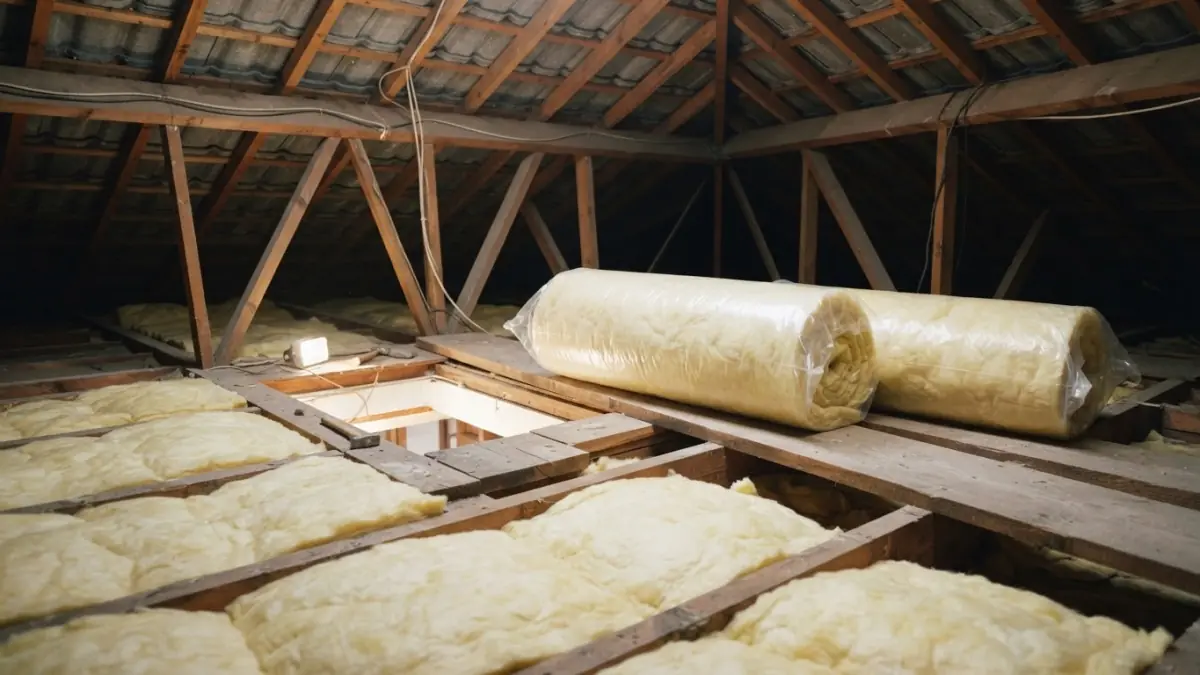
For an accessible cold loft, mineral-wool rolls are normally laid at ceiling level: between the joists, then across them where another layer is needed. The quantity starts with the horizontal loft-floor area, not the sloping roof.
Read here; this page sends and keeps nothing.
Work out the insulation for this loft, then change it to yours
The five figures
- Measure the loft floor length and width. Split a shape that is not rectangular into rectangles and work them out separately.
- Measure the uncompressed depth of insulation already there. If it is wet, damaged, compressed or contaminated, stop and decide what must be removed before treating it as useful insulation.
- Choose the total depth for the complete build-up. Current UK guidance commonly uses 270 mm for mineral wool, but the material and circumstances matter.
- Read the thickness of the exact roll you plan to add.
- Read the square metres covered by one roll or pack at that thickness. The same product range can cover a different area at each thickness.
The sum
Subtract the existing depth from the target. Divide that gap by the new roll thickness and round up to a whole number of equal layers. Multiply the loft-floor area by those layers, add the visible allowance for cuts and fitting, divide by the pack coverage and round up to whole packs.
For a 4.2 m × 3.6 m loft floor:
- floor area: 4.2 × 3.6 = 15.12 m²;
- existing insulation: 100 mm;
- chosen target: 270 mm;
- chosen new roll: 170 mm thick, 8.01 m² per pack;
- one new layer reaches 270 mm;
- 15.12 m² plus 5% = 15.876 m²;
- 15.876 ÷ 8.01 = 1.982, so buy 2 whole packs.
The depths and the 5% are example figures. The 8.01 m² is a typical figure: what one 170 mm roll of Knauf Loft Roll 44 Combi-Cut covers, as Materials Market’s and Travis Perkins’ own listings gave it on 9 October 2026. Replace them all with the label for the product you will use.
Checks the area cannot answer
Measure the joist gap before choosing a width. Keep ventilation paths open at the eaves. Check cables, recessed lights and other electrical equipment because insulation can trap heat. Check cold-water tanks and every pipe because the loft will be colder. Do not lay boards directly on deep mineral wool; safe access or storage needs a suitable raised system and consideration of the joists and load.
A room in the roof, insulation at rafter level, a flat roof, spray foam, loose fill and rigid boards need a different design. Damp, leaks, vermin, fragile ceilings or unknown older materials are reasons to stop and get suitable advice.
Do it with BuildBatch
Open the loft insulation calculator, type the loft floor’s length and width or its area, and answer “How deep is the insulation there now?” In “Change the figures”, type the exact depth there now, the depth to reach and the thickness of the roll you have chosen. For a 100, 150, 170 or 200 mm roll the planner uses a typical figure, the square metres a roll of Knauf Loft Roll 44 Combi-Cut covers as Materials Market’s and Travis Perkins’ own listings named it on 9 October 2026, and says so on the line.
Having it done instead: loft insulation costs gives what UK cost guides publish, per loft and per day, each with the day read.
Sources
Questions
How many rolls of loft insulation do I need for 15.12 square metres?
For one new layer, add the allowance you chose and divide by the square metres printed on one roll or pack, then round up. With 5% extra and 8.01 m² per pack, 15.12 m² needs 2 packs.
Is 270 mm of loft insulation enough?
270 mm is a common UK recommendation for mineral wool, but the right product and build-up depend on the roof, existing material and current guidance. Treat it as a starting figure, not a design for every home.