How much concrete do I need for a slab or shed base?
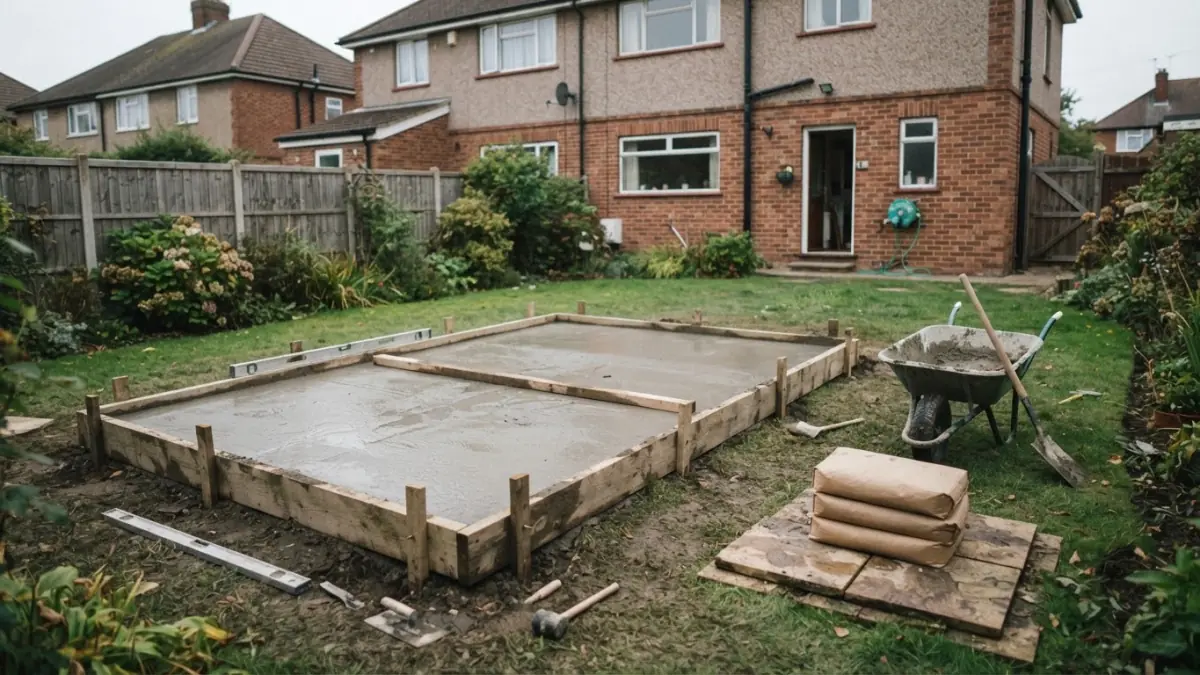
To work out concrete for a slab, a path or a shed base, multiply the area by the thickness to get the volume, add an allowance for an uneven base and spillage, and then either divide by what one bag makes, as printed on the bag, and round up to whole bags, or order that many cubic metres ready-mixed. A 2.4 m × 1.8 m shed base 100 mm thick is 0.432 m³; with 10% extra it takes 48 bags that each make 0.01 m³, or 0.4752 m³ delivered. The thickness is yours to decide: BuildBatch suggests none.
Work out the concrete for a slab
The four figures
- The area. Length times width for a rectangle, in metres, measured inside the formwork. A base that is not a rectangle can be drawn in the calculator, or split into rectangles.
- The thickness, in millimetres. It depends on what the slab is for, the load and the ground, and it comes from the product’s instructions, a designer or building control. The example uses 100 mm because it is a round figure for the sum.
- The allowance. A base is never perfectly level, and some mix is lost in the barrow and the formwork. BuildBatch starts at a labelled 10%, which you can change.
- What one bag makes, in cubic metres, as printed on the bag, and the bag’s weight. Or, for ready-mixed concrete, the step your supplier sells in.
The sum
Area × thickness ÷ 1,000 = the volume in cubic metres (the thickness is in millimetres). Add the allowance once. For bags, divide by the yield printed on the bag and round up to a whole number; for ready-mixed, round up to the supplier’s step.
Worked example
A shed base 2.4 m × 1.8 m is 4.32 m². At 100 mm that is 0.432 m³, and with 10% extra, 0.4752 m³. At 0.01 m³ a bag, 0.4752 ÷ 0.01 = 47.52, so 48 bags; at 20 kg each, 960 kg to carry and mix. Ready-mixed, from a supplier who sells in 0.25 m³ steps, the same base is 0.5 m³.
These are generic example figures. Replace the thickness with the one decided for your job, and the yield and weight with the figures on your bag.
What the sum leaves out
What goes under the slab, and how deep, is not in it: concrete is laid on a prepared, compacted sub-base, never on soil or turf, and sub-base is sold by weight, so the tonnes depend on the material’s density. Whether the slab needs a damp-proof membrane or reinforcement depends on what it is for. Formwork boards run round the edge, pegged firmly on the outside, and the new concrete is protected from drying out, rain and frost while it hardens: the bag’s instructions give the temperature limits, the working time and the protection period. Mixing your own concrete from cement and ballast needs a maker’s mix table, and BuildBatch leaves it out until one has been read.
Wet cement is alkaline and burns skin: wear waterproof gloves, eye protection and boots, and wash any splash off at once.
Do it with BuildBatch
Open the concrete calculator, enter the slab’s length and width or draw its shape, enter the thickness you have decided on, and replace the example yield and allowance with the figures from your bag. It lists the bags or the cubic metres, with the sub-base, membrane, reinforcement, formwork and protection as lines to check first.
Sources
- Tarmac: Blue Circle Multi-Purpose Concrete, product data sheet (December 2023): the yield of a 20 kg bag, the water, the working temperatures, the working time and the protection period, read in full on 5 October 2026.
Questions
How many bags of concrete for a 2.4 m by 1.8 m shed base?
At 100 mm thick the base is 4.32 m² and 0.432 m³. With 10% extra that is 0.4752 m³; at 0.01 m³ a bag it is 47.52 bags, so 48 bags of 20 kg, which is 960 kg to carry and mix. The thickness, the 10% and the yield are generic examples: use the thickness decided for your job and the yield printed on your bag.
How thick should a concrete slab be?
BuildBatch does not say. The thickness depends on what the slab is for, the load and the ground, and it is decided by the product's instructions, a designer or building control. The calculator's 100 mm is a figure for the worked example, not advice.
How much does one bag of concrete make?
It is printed on the bag, and it differs between products and bag sizes. One maker prints about 0.01 m³ for a 20 kg bag of multi-purpose mix. Read your own bag: the yield and the water it needs are the two figures the sum depends on.
Should I buy bags or order ready-mixed concrete?
Bags suit a small base you can mix by hand or in a mixer. For a larger slab the weight adds up fast: 48 bags is nearly a tonne. Ready-mixed concrete is ordered by the cubic metre, rounded up to the step the supplier sells in, and suppliers have a minimum load, so ask.