What you need to wallpaper a room: the full list
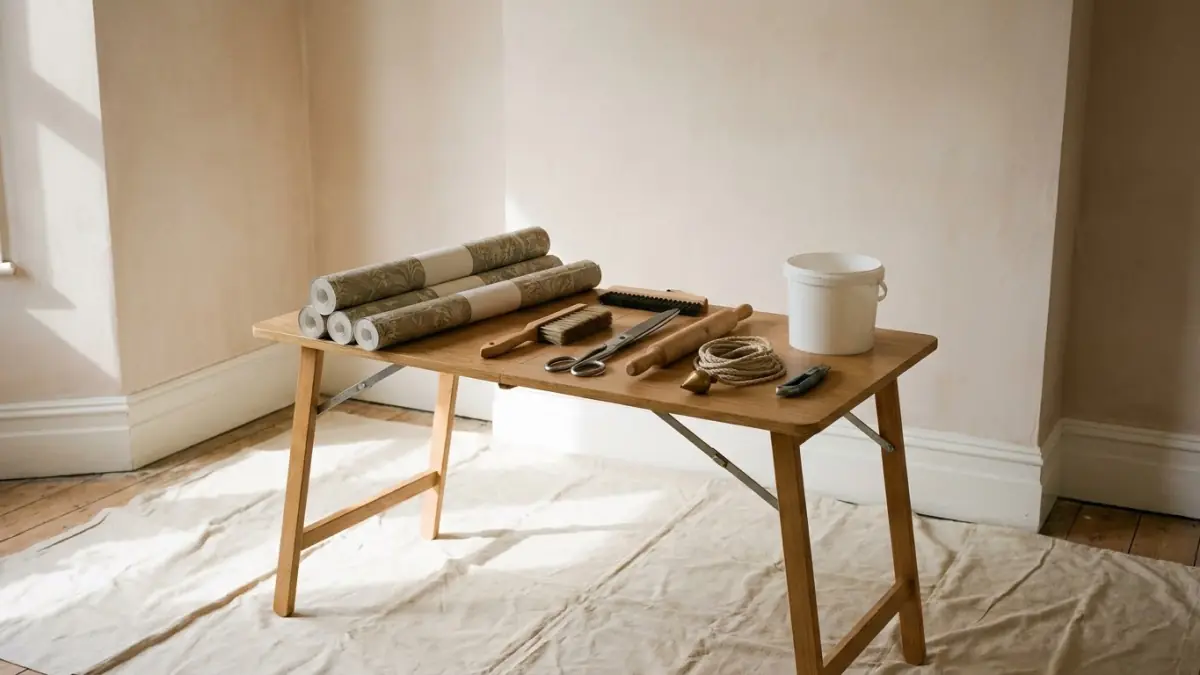
To wallpaper a room you need the rolls, the paste the paper’s label asks for, sugar soap, filler and abrasive paper to get the walls clean and flat, dust sheets, and the tools to cut, paste and hang: a pasting table, a paste brush, a smoothing brush, a seam roller, a sharp knife with spare blades, scissors, a straight edge, a plumb line or spirit level, a tape measure, a pencil, a filling knife and scraper, and a bucket and sponge. Lining paper is the line to decide on, and sizing the walls is a job to do first. A 4 m × 3 m room with walls 2.4 m high takes 7 rolls of 53 cm × 10.05 m paper with no pattern to match, which is an example roll, and 10 rolls while the paper’s match is not known.
Read here; this page sends and keeps nothing.
Work out the wallpaper for this room, then change it to yours
The checklist
These are the lines BuildBatch lists for papering a room whose walls are painted and sound, with where each one starts. “To decide” means it may need buying, and something the list cannot know decides it: the line asks its question. “Before you start” is a job to do first, not a thing to buy.
| Item | Starts as | Why it is on the list |
|---|---|---|
| Wallpaper, in whole rolls | To buy | Counted in whole drops from each wall’s width, the height and the roll’s label |
| Wallpaper paste | To buy | Counted at 4 rolls to a “5 roll” packet, a typical figure. Some papers are paste-the-wall, some are ready-pasted and need none |
| Lining paper | To decide | Hung first on poor or patched walls, and under heavy or expensive papers |
| Sizing the walls | Before you start | New or bare plaster, and very porous walls, are sealed with size or diluted paste so the paper slides into place and sticks |
| Sugar soap or wall cleaner | To buy | Paper sticks to a clean wall. One container does a room |
| Filler for cracks and holes | To buy | Small cracks and holes are filled and sanded flat first: paper shows every bump |
| Abrasive paper or sanding sponges | To buy | For rubbing filler flat |
| Dust sheets | To buy | To cover the floor |
| Filling knife and scraper | To buy | For filling and for removing anything loose |
| Pasting table, paste brush, smoothing brush, seam roller | To buy | To paste the drops and hang them flat, with neat seams |
| Sharp knife with spare blades, scissors, a straight edge | To buy | A blunt blade tears wet paper: change it often |
| Plumb line or spirit level, tape measure, pencil | To buy | The first drop on each wall is hung to a true vertical line, not to the corner |
| Bucket and sponge | To buy | To wipe paste off the face of the paper and the skirting |
What the label decides
- The rolls. Four figures on the roll’s label decide the count: the width, the length, the pattern repeat and the match. BuildBatch starts with a roll 53 cm wide and 10.05 m long, labelled as an example, and until you say whether the paper has a pattern it counts a straight match with a 64 cm repeat, so the rolls do not run short. The figures on your label replace both. The sum is in how many rolls of wallpaper do I need?
- The paste. The label says how the paper is hung: paste the paper, paste the wall, or ready-pasted. The paste packet says how many rolls it hangs; divide the rolls by that and round up. BuildBatch counts 4 rolls to a packet sold as a “5 roll” packet, the lower figure on the one maker’s data sheet read, so a heavier paper is not left short. Wallpaper paste: how many rolls does a packet hang? sets four makers’ figures side by side.
- Buying the rolls together. Buy every roll with the same batch number on the label: colours differ between batches.
What the walls decide
- Painted and sound. The list above. How much filler depends on the walls: a small tub is usual for a sound room.
- New or bare plaster. Sizing the walls is under “Before you start” on every list; on new plaster it is not optional. The paste’s instructions say how.
- Flaking, powdery or glossy paint, or old wallpaper. A line is added under “Before you start”: stripping old paper or loose paint. New paper goes on a sound, clean wall, so old paper and flaking paint come off first, with a scorer and a scraper, or a steam stripper for stubborn paper.
- Poor or patched walls. Lining paper first. If you need it, it is counted the same way as the paper.
Older paint can contain lead, and textured coatings applied before 2000 can contain asbestos: do not sand or scrape a coating you are not sure about; get advice first.
Worked example
A bedroom 4 m × 3 m with walls 2.4 m high, one door 762 × 1981 mm and one window 900 × 1200 mm, walls painted and sound. No paper has been chosen, so the roll is the example, 53 cm × 10.05 m. It is not any product’s roll. The paper here is plain, with no pattern to match.
- Wallpaper: walls of 4 m, 3 m, 4 m and 3 m take 8, 6, 8 and 6 drops, 28 in all, each 2.5 m long. Four drops come from each roll, so 7 rolls, with no spare drop. To buy.
- Wallpaper paste: for 7 rolls, at a typical 4 rolls a packet, 2 packets. To buy.
- Lining paper: 7 rolls of 53 cm × 10 m, a typical roll, for the 31.01 m² of wall, if it is needed. To decide: the line asks “Lining the walls first?”
- Sizing the walls: before you start.
- Sugar soap or wall cleaner: 31.01 m² to wash down. To buy.
- Filler: a small tub is usual for a sound room. To buy.
- Dust sheets: 2 sheets of a typical 3.6 m × 2.7 m, for the 12 m² floor. To buy.
- Abrasive paper, and the tools in the last five rows of the checklist: to buy.
That is eleven lines to buy, one to decide and one job to do first.
The door and the window are not taken off the rolls. The short drops above and below them come from the same rolls, and every corner wastes a strip, so whole drops are counted for every wall.
Seven rolls with no spare drop is tight: one mis-cut leaves you a roll short, and one more roll with the same batch number is easier to buy now than a match later. The list says so on the line.
A pattern changes the count, and so does not knowing it. The same room in a paper with a 53 cm straight-match repeat has drops of 2.65 m, only three to a roll, so it takes 10 rolls, with 2 spare drops, and 3 packets of paste. While the match is not known the planner counts a straight match with a 64 cm repeat: drops of 2.56 m, three to a roll, and the same 10 rolls. It says so, and that a plain paper needs fewer.
The whole list for this room, with the working behind each quantity, is in the worked example for wallpapering a 3 × 4 m bedroom.
Do it with BuildBatch
Open the wallpaper calculator, choose “The whole room”, type the room, and say whether the paper has a pattern to match: type the repeat from the label under “Pattern repeat”, and the roll’s width and length under “The roll and its match” in “Change the figures”. “See the list and buy” shows the rolls and every other line above, with the reason each is there; the paste is counted with them, and the lining paper’s line asks whether you are lining the walls first.
What this guide does not cover
How to hang the paper, which its label and the paste’s instructions give. Which paste a paper needs. Papering a ceiling. Stairwells, which need proper access equipment. Removing a textured coating. Diagnosing damp.
Related guides
Questions
What tools do I need to hang wallpaper?
A pasting table, a paste brush, a smoothing brush and a seam roller; a sharp knife with spare blades, scissors and a straight edge; a plumb line or spirit level, a tape measure and a pencil; a bucket and sponge; and a filling knife and scraper for the preparation.
Do I need lining paper?
It is hung first on poor or patched walls, and under heavy or expensive papers. Whether you need it depends on the walls and the paper: the label often says. If you do, it is counted the same way as the paper.
Do I need to size the walls before wallpapering?
New or bare plaster, and very porous walls, are sealed with size or diluted paste so the paper slides into place and sticks. The paste's instructions say when walls need sizing and how.
How much wallpaper paste do I need?
The paper's label says which paste, or none: some papers are ready-pasted. The packet says how many rolls it hangs. BuildBatch counts 4 rolls to a packet sold as a 5 roll packet, a typical figure from one maker's data sheet: 2 packets for 7 rolls, 3 for 10.