How many rolls of wallpaper for a feature wall?
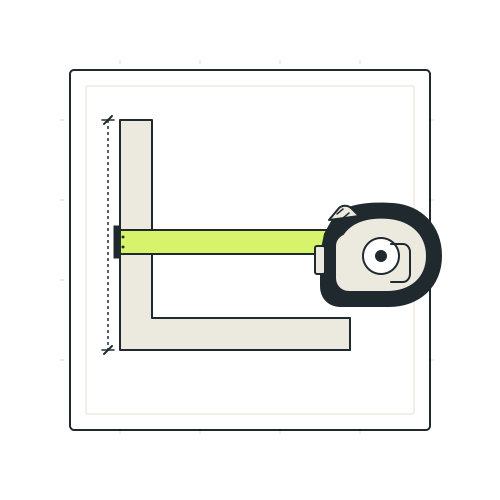
Divide the wall’s width by the roll’s width and round up: that is the number of drops, and the roll’s length and pattern repeat decide how many drops come from each roll. A wall 3.6 m wide and 2.4 m high takes 7 drops of the example roll, 53 cm wide and 10.05 m long: 2 rolls with no pattern to match, and 3 rolls with a 53 cm straight-match repeat. The roll is a generic example, not a product: the figures on your label replace it.
A drop is one full-height length of paper, from the ceiling to the skirting.
The steps
- Measure the wall’s width, and the height from the top of the skirting to the ceiling.
- Drops = the wall’s width ÷ the roll’s width, rounded up.
- Drop length = the height plus about 10 cm, for trimming at the top and the bottom. With a straight match, round that up to a whole number of pattern repeats. With a half-drop match, add half a repeat as well.
- Drops per roll = the roll’s length ÷ the drop length, rounded down. A part-drop left on the roll is waste.
- Rolls = the drops ÷ drops per roll, rounded up.
It is the same sum as for a whole room, on one wall. How many rolls of wallpaper do I need? does all four walls.
Worked example
A wall 3.6 m wide and 2.4 m high, and the example roll, 53 cm wide and 10.05 m long.
With a free match, a paper with no pattern to line up:
- Drops: 3.6 ÷ 0.53 = 6.79, so 7
- Drop length: 2.4 + 0.1 = 2.5 m
- Drops per roll: 10.05 ÷ 2.5 = 4.02, so 4
- Rolls: 7 ÷ 4 = 1.75, so 2 rolls, with 1 spare drop
With a straight match and a 53 cm repeat:
- Drops: 7, as before
- Drop length: 2.5 m rounded up to five repeats, 2.65 m
- Drops per roll: 10.05 ÷ 2.65 = 3.79, so 3
- Rolls: 7 ÷ 3 = 2.33, so 3 rolls, with 2 spare drops
A quick table
Walls 2.4 m high, in the example roll of 53 cm × 10.05 m:
| Wall width | Drops | Rolls, free match | Rolls, straight match with a 53 cm repeat |
|---|---|---|---|
| 2.4 m | 5 | 2, with 3 spare drops | 2, with 1 spare drop |
| 3 m | 6 | 2, with 2 spare drops | 2, with no spare drop |
| 3.6 m | 7 | 2, with 1 spare drop | 3, with 2 spare drops |
| 4.2 m | 8 | 2, with no spare drop | 3, with 1 spare drop |
| 5 m | 10 | 3, with 2 spare drops | 4, with 2 spare drops |
A half-drop match with the same 53 cm repeat gives the same roll counts at this height: its drop is 2.915 m, and three still fit on a roll.
Two of those counts leave no spare drop. One mis-cut would leave you a roll short, and one more roll with the same batch number is easier to buy now than a match later.
A taller wall
The height changes how many drops a roll gives. With walls 2.7 m high, a plain drop is 2.8 m, so the example roll gives three drops instead of four, and the 3.6 m wall takes 3 rolls instead of 2. With a 53 cm half-drop match the drop is 3.445 m, only two fit on a roll, and the same wall takes 4 rolls.
A chimney breast
Each face is counted as a wall of its own, because every corner wastes a strip. Take a chimney breast 1.67 m wide that sticks out 0.26 m, 2.4 m high:
- The face alone: 1.67 ÷ 0.53 = 3.15, so 4 drops. One example roll of plain paper, with no spare drop.
- The face and both sides: 4 + 1 + 1 = 6 drops. Two rolls of plain paper, with 2 spare drops.
The sides are narrow, but each still takes a full-height drop.
Doors and windows
They are not taken off. The pieces above a door and below a window are still cut from full drops, so that the pattern carries on across them. Count the drops across the whole width of the wall.
What to check first
- The label. The width, the length, the pattern repeat and the match are printed on the roll’s label. Many UK rolls are 53 cm wide and 10.05 m long; wider rolls and other lengths exist, so copy the figures off the paper you are buying.
- The rolls. Buy every roll with the same batch number on the label: colours differ between batches.
- The wall. Paper shows every bump and crack, so the wall is washed, filled and sanded flat first. What you need to wallpaper a room has the paste, the preparation and the tools.
Do it with BuildBatch
The wallpaper calculator counts every wall of a room, not one wall on its own, so for a feature wall use the steps above with the figures from your roll’s label. The roll counts on this page come from the same arithmetic the calculator uses. If you paper the whole room, it counts the rolls, the paste and the tools from one set of measurements.
What this guide does not cover
Where on the wall to start, and how to centre a pattern. Murals. Sloping ceilings. How to hang the paper, which its label and the paste’s instructions give.
Related guides
Questions
How many rolls of wallpaper for a feature wall 3 m wide?
With 53 cm × 10.05 m rolls, an example roll, and a wall 2.4 m high, 2 rolls. The wall takes 6 drops, and a roll gives 4 drops of plain paper or 3 with a 53 cm repeat. With the repeat there is no spare drop, so one mis-cut leaves you a roll short.
Is one roll enough for a feature wall?
Only for a narrow one. On a wall 2.4 m high, a 53 cm × 10.05 m roll of plain paper gives 4 drops, which cover a wall up to 2.12 m wide. With a 53 cm straight-match repeat it gives 3 drops, enough for a wall up to 1.59 m wide.
Do I take off a door or a window in the wall?
No. The pieces above and below them are still cut from full drops so the pattern lines up, so whole drops are counted across the whole width of the wall.
Can I divide the wall's area by the area of a roll?
For a plain paper it often gives the same answer, but it ignores the paper lost to matching a pattern. A wall 3.6 m × 2.4 m is 8.64 m² and a 53 cm × 10.05 m roll is 5.3265 m², which says 2 rolls. A paper with a 53 cm repeat needs 3.